Friday, March 29, 2013

Asset Management - Free Textbook

Andrew Ang has posted a draft of a textbook he's working on called Asset Management (the section after working papers).  Andrew is a young giant in the field of empirical asset pricing.  There's a reason I snoop around his website to see what he's up to as I think he's one of the most exciting people working in the field right now.

I'm not sure what the target audience for the book is, but it seems very readable.

Monday, March 25, 2013

Inventing Conservative Environmentalism: Part 0

By Robert H.

Charlie's been raising good points in the comments to my last post that have convinced me that 1. The post wasn't well written, 2. My ideas were muddied.

So, rather than simply assert that coming up with a unique, conservative environmental plan is really hard, I'm going to try to demonstrate it.  Over the next few days I am going to examine every plausible principle I can think of that could underlie conservative environmental policy.  I'll start with the principles that I think underlay conservative environmental policy in the 70's, then look at the new principles that Adler outlined in his paper, then look at all the other principles I can think up.  I suspect I'll find that principles either, 1. Aren't that useful, 2. Aren't that uniquely conservative, or 3. Aren't that important.  But maybe not!

But first, I want to clarify what I mean when I say "conservatives don't have a workable, unique environmental policy."  Because I don't mean a lot of things.  I don't mean: 1. Liberals are right on all environmental policy questions, 2. The policies and ideas that comprise the liberal status quo all come from liberals.  Cap and trade, for example, was a conservative idea before liberals embraced it.  3. In the future everyone is going to agree on environmental policy. 4. There aren't dumb liberal ideas that conservatives will never embrace, or 5. liberals will, in the future, have a unique environmental vision.

To understand what I do mean, think about military policy.  Liberals and conservatives used to have BIG differences when it came to the military: liberal Machiavelli thought the military should be composed of volunteer citizens, conservative Louis IV was all about standing armies, Thomas Jefferson wanted militias, Napoleon liked conscription, conservatives tended to what an officer class drawn from the aristocracy, liberals wanted a meritocratic military, the USSR abolished officers, then it brought them back, etc.  Most recently, there have been fights over whether homosexuals can serve and whether women can serve in every role.

Well, most of that is settled in America, and conservatives and liberals don't much have big ideological differences anymore.  At least, not compared to centuries past.  Large, standing, volunteer, army.  Officers class is defined by having a college degree and getting into and passing certain training programs.  People are promoted base on need and merit in an up-or-out system.  Five branches.  Etc.

But that doesn't mean that conservatives and liberals agree on military policy, it just means they aren't fighting fundamental  ideological battles.  There are still questions of whether funding should go up or down, what wars should we fight, how should we address rape, should we pay more attention to higher education credentials when promoting officers, should we fund this program or that one, etc.  So while I think it would be accurate to say, "liberals and conservatives can't articulate plausible, fundamentally different visions about the military," it's still true that there is plenty for them to fight about, and clear differences between the parties.

That's where I see environmental policy headed.  The big, fundamental ideological differences between the parties are becoming less and less tenable, and differences are starting to be matters of "is this specific policy right or wrong," not big questions like "should the federal government regulate water?"

So, since I see convergence between the parties, and could just as fairly say "in the future liberals won't be able to articulate a clear, ideological difference on environmentalism," why am I focusing on the conservative side of the story?  Because they are fighting this convergence the hardest!  Adler's essay outlines three paths for conservatives: 1. Just sort of reflexively oppose all environmental regulation ever, 2. Basically call for the same things as the liberals but on a smaller scale and trying to be more market oriented, 3. Outline a bold new conservative vision for environmental policy.  He sees most conservatives these days going down path 1, but he wants path 3.  I am writing because I think conservatives need to get over it and accept path 2, or else actually come up with the bold new vision along path 3.

I hope that made more sense than my last post!  Anyways, my future posts in this series will be shorter and more concrete.  Also, in case you for some reason think I will be, know that I won't be blogging tomorrow because THE US IS PLAYING MEXICO IN WORLD CUP QUALIFYING WHY DON'T YOU KNOW THAT ALREADY.

Thursday, March 21, 2013

Product of His Environment

By Robert H.

I was excited to read that Jonathan H. Adler had written an article entitled Conservative Principles of Environmental Reform, and even more excited when I read an interview with him entitled "Yes, Conservatives Can be Environmentalists   Here's How."  For years now I've thought that conservatives need to come up with a plausible environmental program, and this promised to show me a conservative who had done just that.

Unfortunately , he has not.

To explain this, we need to review the ideological bidding:  Recall that there are two big economic problems with pollution.  

1. The tragedy of the commons.  Because no one owns common resources, the incentives to preserve them don't work out right.

2. Transaction costs.  Because pollution injures a lot of people a little, the transaction costs to get them all together and deal with the polluter (either by suing him or paying him to stop) can be too high.  

In the 60's and 70's, conservatives and libertarians had clear answers to these problems.  Nozick outlined this in Anarchy State and Utopia, for example (such a good book you guys).

1. Privatize the commons.  If the government sells off all the common resources to the highest bidder, we can a. make sure incentives line up right for preserving those resources  and b. use the proceeds to help the common good, keeping the little guy from getting hosed.

2. Class actions.  Create a legal mechanism by which people can easily aggregate and sue polluters.

But then, over the coming years, problems undermined these solutions.

1. New kinds of air pollution.  Back when people thought of air pollution as a factory pouring smog into the air next door, you could kind of see how "privatize the resources" could work.  Treat the pollution like a trespass on all the nearby land it worsened the air quality over, let those landowners sue.  But when we realized that polluters were making microscopic contributions to continental or global air quality problems -- acid rain in the northeast, ozone holes over the antarctic, global warming -- it wasn't clear how to create a private property interest that could solve the problem.  The damage was to the entire atmosphere, the individual polluters contribution to it minimal and hard to separate out.  What do we do in response to that, sell the atmosphere?  Expect everyone who owns land on earth to get together and sue him?  Try to track down where the individual sulfur atoms he pumped into the air went?  There was no good solution.

2. Class actions turned out to be a mess.  Trying to simplify the costs of coordinating all those people just isn't possible without creating terrible agency problems (you basically end up with a lawyer who isn't actually working for his clients, and whose clients might not even know he exists), and at this point both conservative and liberal lawyers have pretty much given up on class actions.

So conservatives have never recovered from that.  They've basically spent the last few decades with wax in their ears, claiming that in every case the cost of pollution is overhyped and the cost of government intervention underhyped and so we should never regulate pollution ever.  They're probably right in a lot of individual cases, but as a universal answer to the problems posed by pollution it is wanting, and the empirical evidence supporting it seems week (IE, there have been some low cost, big success regulations of pollution).  Meanwhile, the liberals have workable answers to both the problems raised in one and two:

1. Deal with air pollution with cap and trade or taxes (from an economic perspective they get they same result).  

2. Deal with the aggregation problem by having government centrally regulate polluters (this imposes inefficiencies and risks regulatory capture, but, again, I think conservatives are nuts to claim that in every case the inefficiencies outweigh the gains).  

***

Ok, so that is out of the way, and the stage is set for Adler to finally come up with a conservative answer to the problems that stifled conservative environmentalism   Fortunately, he is able to express his solutions in one, succinct answer.

BP: So how do you use property rights to align incentives in other areas, like air pollution? 
JA: We do have to recognize that in many areas we still don’t know how to do that. We know what it might look like. In the pollution context, it would mean that every polluter would be held responsible for the pollution it generates. We don’t yet know how to make the tort system do that efficiently. But we know that’s the incentive we want. And the closer we can get to that ideal, the more we’re going to produce environmental results.

So... that's disappointing.  He doesn't know how to regulate air pollution and doesn't have a better tort solution than class actions, but he wants those better solutions to exist.  Good for him?

  He does have some specific ideas about global warming, though:


BP: So that’s the case that conservatives should pay attention to climate change. But what does that mean for policies to deal with?JA: I’m not a fan of regulating greenhouse gases under the Clean Air Act, I don’t think that’s particularly effective or efficient. But I don’t see the argument for doing nothing. I don’t think that’s consistent with conservative principles. So I’ve done papers on adaptation and how do we get the degree of energy innovation that many people think will be necessary. And most controversially, I’ve argued that a revenue-neutral carbon tax would be a good idea.

Oh.  He wants a carbon tax.  Like the liberals.

So his conservative solution to the problems plaguing conservative environmentalism are 1. Surrender to the liberals.  2. Figure something out.  Disappointing.


***

Seriously though, Adler makes some good points.  If I could force his argument into my paradigm (which is not his paradigm, and it's worth reading what he has to say in his own words), it would be 1. Conservatives need to stick to our "just privatize the commons" approach and fight for it aggressively in the places it works. 2. In the places it doesn't work, like air pollution, we need to be thinking hard to come up with something.  3.  We also need to be thinking hard to come up with a better tort system.

Then, as a sort of general 4. He does a lot to feed into the current conservative argument (centralized regulation of the environment, like liberals want to do it, is super super costly it is just terrible you guys).

Those are all fair and good points, they just fall super short of bringing conservative environmental policy back to where it was forty years ago: sitting pretty with a plausible story for how conservatives can protect the commons.

***

As an aside, I would add that environmentalism raises non-economic problems: for some people (IE, hippies) it is an inherently negative outcome when animals go extinct or biomes cease to exist or whatever.  If you value some piece of nature more than is economically efficient (IE more than people are willing to pay for it), then even the broad outlines of conservative environmentalism Adler presents won't do much for you.

Tuesday, March 19, 2013

Sympathy Empathy Doc

By Robert H.

So I am going to start this boringly and at a high level of abstraction, but I think laying the groundwork is important:

Empathy is when you know all too well what someone is going through, can put yourself in their situation, and you actually sort of feel their pain.


Sympathy is when you can't put yourself in someone's shoes or really understand what they are going through, but you still feel bad for their pain.

An interesting distinction between the two is that you can't really have mixed emotions about the subject of your empathy (if I am feeling what you are feeling, I can't be also feeling that, say, I hate you, because you aren't feeling that), but mixed emotions are possible (and common?) with sympathy.  I can feel bad for your suffering but also be sort of glad it is happening and also be confused about the contradiction and also want you to get over it and stop whining.


I bring all this up because I was always raised to believe that sympathy is never wrong.  If someone says, "I'm glad he's dead, and I wouldn't have preferred a different outcome, but I still sort of feel bad for Hitler, dying alone and beaten in a bunker," I would think, "Ok.  That's pretty damned charitable, and I don't feel that way, but good for you."  Being able to see the humanity in monstrous people isn't bad, it's the sign of a saint.

The problem, I was always taught, is when you either 1. Let your sympathy get the better of your judgment, and go from feeling bad for someone to excusing them from the consequences of their actions; or 2. Actually start empathizing with bad people.  If someone says "I feel bad for Hitler, I wish he had escaped to Argentina" or, even more creepily, "I totally feel Hitler's pain.  His noble attempts to conquer Europe overthrown, the evil Allies closing in on him, forced to take his own life..." then that's disgusting and wrong.

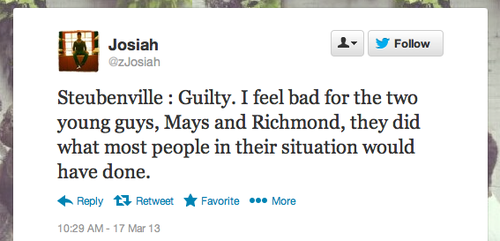
I bring all this up because there has been a lot of weird (if predictable) empathizing/taking-sympathy-too-far with the two kids recently convicted of raping their classmate in Steubenville.  Here's a tumblr that is collecting some examples (plus examples of people attacking the victim).  Terrifying stuff like:


That is clearly someone who empathizes with rapists, and that's terrible.

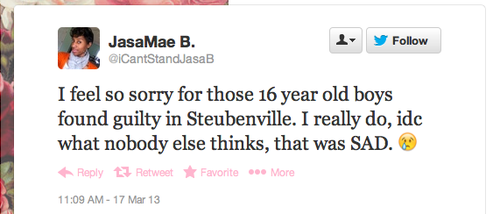
But in the rush to go after people like that, I've seen people simply expressing sympathy for the rapists being swept up in the same pile of dust.  That same tumblr, for example, contains this entry:


Now that certainly wasn't my reaction, and I think there's a good chance that that dude, if you pressed him, would reveal that he's fallen into one of the two errors I talked about above.  But I don't see absolute proof of that in the tweet as written.  Some young kids are going to jail and this dude feels bad for them and thinks it is sad.  We don't know if he thinks the verdict is wrong, or if he blames the victim, or if he is imagining himself in the boys' shoes, or if he is feeling other emotions, we just know he feels sympathy for bad humans experiencing something bad.  Let him!  Sympathy is fine!

As a less borderline example, CNN's coverage of the sentencing has come under fire.  Part of the criticism is just wrong (that writer goes after CNN for focusing on the rapists but leaving the victim a nonentity, but she is only looking at a snippet of the broadcast.  Later in the broadcast, and seemingly as soon as possible, they did, in fact, seek out a representative for the victim (her attorney), inquire after how she was doing, and give him a chance to speak on her behalf.  They also reported on the victim's mother's reaction to the sentencing), part of the criticism is absolutely right (that writer missed it, but CNN broadcast the victim's name, which is inexcusable), but some of it falls prey to this sympathy/empathy thing.  People hear CNN reporters expressing sympathy for the rapists and talking about what a shitty turn their lives will now take and assume that they are either excusing them or empathizing with them or trying to make the viewer like the rapists more or implying that everyone should feel the way the cnn reporters do.  Maybe I'm tone deaf, but I didn't hear any indication of that, I just heard sympathy.  I think the reporters were just expressing what they felt  they just watched some sad people getting their life destroyed and feel kind of bad for them.  That's not the worst way to feel.  Had the reporters only expressed that sympathy, and not counterposed it with the heinousness of the crime and the suffering of the victim (which they didn't do enough of, I admit, in the clip that writer is spotlighting.  But again, that clip was not the whole broadcast), I think you could fairly criticize them.  And even as is I think you could say, "man, that's not how I would have reacted to or reported that trial."  But saying, "No sympathy on the TV for violent criminals!  Ever!"  strikes me as a bit much.  Feeling sympathy for bad people is fine!  

As a caveat, I admit I might be mixed up about this "sympathy is never wrong" axiom.  

And just to clarify: yes, obviously I am glad that the two rapists are going to jail, and no, I don't feel much sympathy for them.  I do feel bad for the rapists' families, though, and I also think my feelings might be different if I had been at the sentencing hearing (I think I would both feel both more sympathy and even more hatred and disgust for the criminals.  Sentencing hearings are emotional, yo).   

Lastly, I just want to emphasize that "idiots blaming the victim or excusing the criminals" has been a much bigger, more noticeable, and badder problem in the aftermath of this trial than "excessive policing of sympathy" has been.  Rape culture is a million times worse than is people over-zealously attacking examples of rape culture.  I'm writing about the second thing because I haven't  seen anyone make the point I want to make (a good sign I'm wrong?), not because it's more important than the first thing.

P.S. I won't be able to update tomorrow.  Apologies.

Monday, March 18, 2013

Undocumented Founders

By Robert H.

So I just got linked to this post from over a year ago, pointing out that a lot of our ancestors were illegal migrants (people started illegally settling unclaimed land on the frontier well before the government started giving it away for free).

But this doesn't go nearly far enough!  Americans have a long and proud heritage of illegal migration/immigration, and it should be recorded.  The stuff I can think of off the top of my head:

1. Before America banned Mexicans from migrating to Texas, Mexico banned Americans.  Freaked out by all the yanquis moving in up North, President Bustamente banned American emigrants from settling in Tejas in 1830.  This did not work, and by the time the ban was rescinded thousands of anglos had illegally settled in el estado de la estrella solitaria.  No doubt their descendants fight tirelessly on behalf of undocumented workers to this day.

2. Boomer Sooner.

3. In 1763, Britain banned American settlement West of the Appalachians, declaring the whole region an Indian territory.  Needless to say, this did not stick, on the one hand because the King kept carving out exceptions and on the other hand because anyone with a mind to move West simply ignored the ban, emigrating joyfully and illegally into the vast, unpeopled wilderness  some miffed Native American's back yard.

4.  America abolished the importation of slaves in 1807.  Nevertheless, between 1810 and 1851, about 50,000 African slaves "immigrated" to the US.  By 1865, most of these illegal immigrants had been granted amnesty.

What have I missed?

P.S. Apologies for not blogging Friday and for waiting so late to blog today.  Work has been busy, but I'll try to stick to weekdaily blogging.

Thursday, March 14, 2013

1. Bad incentives 2. ? 3. Crisis!

By Robert H.

I am made very nervous by public choice stories that end in doomsday.  Take these examples: 1. As soon as the people realize they can vote themselves subsidies, they will vote themselves more and more until the economy collapses.  2. Because a possible debt crisis is a long way off but tax hikes and budget cuts happen now, politicians will always face pressure to please current voters and hurt future ones, never getting serious about the deficit until crisis is upon us.  3.  If markets start poking up interest rates and servicing our debt becomes a crushing burden, the fed will feel pressured to enact looser and looser policy to keep rates down until an inflationary disaster.

To state the obvious, in a rich, transparent democracy like America, there is a huge and powerful constituency that wants to avoid doomsday (everyone) and widespread access to good data about the likelyhood of doomsday.

So, to take one example, are politicians pressured to borrow now at the expense of future generations?  Probably.  Will this lead to a fiscal crisis?  Probably not.  You would expect rational voters likely to see a fiscal crisis in their lifetime push for balanced budgets.  If it looks like the debt to GDP ratio won't be sustainable in 20 years, maybe the 80 year olds don't care (they will be dead by then).  But the 20, 40, and maybe 60 year olds do.  As we approach fiscal crisis danger territory, older and older voters should start getting politically involved for austerity until the fiscal crisis is averted, later than would be optimal but far earlier than is dangerous.

Because the constituency against doomsday is so large and powerful, it is hard to tell public choice stories where rational actors end up dooming America.  Doomsday takes either 1. Ignorant voters (and why do you think you are so much smarter) or 2. Bad institutions that a.  hide key facts from voters, b. make coordination hard (IE, climate change is a global problem but there are no global institutions capable of dealing with it), or c. Put power in the hands of people who prefer doomsday to the alternative (IE, ruling junta would rather control a collapsing economy then risk losing control of a free one).  I would say Europe has suffered from a mix of all three factors under 2, hence the crises there.

Wednesday, March 13, 2013

How I know Work Requirements are Mean

By Robert H.

People who want to couple wealth redistribution with work requirements (making people look for a job to get UI, redistributing wealth with wage subsidies rather than hand outs, whatever) often say they are trying to fix incentives.  Just giving a low income person money removes a lot of his incentive to work.  So it makes sense to require the people we are giving money to to work.  From an "economic efficiency" standpoint, anyway.

But this is pretty much the only place I hear that argument?  For example, the money we are giving the poor person was taxed (or borrowed, in which case it will be payed for with a tax later).  If it was taken as an income tax, it lowered the incentive for rich and middle class people to work, since their post-tax salary is going to be less for the marginal hour worked.  So why not just require them to work more hours!  Make people in the top tax bracket work 80 hour work weeks, the bracket below that 60 hours, etc., with a big tax penalty for people who don't work  the "right" amount.  Problem solved!  Instituting a sales or VAT tax?  Command people to consume more!  Problem solved!  Spending money on a sugar subsidy?  Just order people to eat more sugar substitutes!  Problem solved!   It's a bright new day for economics, and we can finally tax and subsidize people with no dead weight loss!

This is crazy, and would not work.  Everyone knows it wouldn't work.  Bureaucratic orders simply aren't a substitute for actual market incentives, and if you are going to tax or subsidize someone you should just accept that that is going to screw up incentives and move on.  But, for some reason, when we turn to subsidizing poor people, free-market types see it as a self-evidently correct to try to stamp out the disincentive to work.  Why does so much effort go into coming up with ways to give a poor person money while requiring them to work more hours, and so little effort go into figuring out ways to tax a rich person's income in a way that requires he work more hours?  I can't really explain that, other than as moralizing (people don't deserve hand outs unless they are willing to work) attitudinal bias (of course ordering those poor people to work makes sense.   Of course it doesn't make sense with us middle class and rich people) or a sort of fuzzy argument form history (panem et circenses!).

I honestly feel like I am missing something, though.