
Matt Yglesias has really pioneered doing cutting edge policy analysis on Westeros, but I think his latest posts have been way too skeptical about house Lannister's power base. The argument, in short, is that the main Lannister assets are gold and people owing them money. House Tyrell, on the other hand, is rich in fertile land. Fertile land feeds people and armies; unleashing stores of gold just inflates the money supply, so House Tyrell for the win.
It's an interesting argument, but far too modern. He even uses an early modern example -- The Hapsburgs -- when he should be thinking along medieval or classical lines. In the world before 1453, the race was not always to the swift, nor political power to the highest NGDP. Some reasons House Lannister has real power and a real chance to win the throne:
 |
| Meow! |
1. Medieval and Classical armies foraged. Caesar, a logistical genius, sent his legates *ahead* of the army to negotiate grain supplies, he didn't amass grain *behind* the army and ship it to the front (with rare exceptions). Shipping food to armies is just too hard with medieval or classical technology (especially organisational technology). So in that context being relatively rich in fertile land is sort of bad -- it makes it easier to fight on your land, where the foraging is good, and harder to fight on the other guy's land, where the foraging is bad.
2. It is easier to defend gold than grain. Build a big castle on a big rock, station a big army there, and put the gold under it. Defended! Grain wealth, on the other hand, is tied up in diffuse, hard to defend fields. You can store some of it but
3. Medieval crop yields were not the best. Much of your grain has to be reinvested in planting the next year's harvest or in feeding the peasants. Which makes being a super populous region a mixed blessing: more people to enlist, but also more people to feed.
4. And can you enlist them? For one thing, if you march your people away to fight they can't plant or harvest the next crop and you starve. This is one of the reasons nomadic societies (or people who can afford to pay nomadic societies) were often so much better at conquering. For another, Westeros seems to have a pretty primitive sort of feudalism in which lords call on vassals to produce troops in times of war. The actual power of House Tyrell to mobilize its people hinges on convincing dozens of minor lords to honor feudal obligations to the house. But the Lannisters can make competing offers to get them to change sides -- possibly even with some moral force behind them, if the Lannisters occupy the iron throne. So who do people choose? This gets us to point five:
5. Medieval and classical societies often didn't have super-strong institutions, meaning that PEOPLE mattered a lot more. Like, individual dudes. King Richard is king and everything in England is relatively fine. Then John is king and French armies are marching all over English soil and barons are revolting and magna carta and the Pope now owns England and it is a mess. Then Henry III is king and everything goes back to being fine again (for a bit). The lannisters being rich helps them in the person power dimension along several fronts:
A. "A lannister always pays his debts." Their gold has let them make and keep an enormous number of contracts, building a universal reputation for keeping their end of bargains. In contrast, their money lending and easy attitude towards debtors has ensured that countless houses have publicly made and *failed* to keep contracts them. In other words, the Lannisters have the most important thing you can have in an anarchic environment where you can't count on good institutions to make people abide by a contract: you can trust them to keep a deal. Even better, they've worked hard to make sure you can't trust anyone else.
B. Their wealth is liquid. In an anarchic free-for-all war, the guy who can pay you gold *now* is a lot nicer to work with than the guy who can promise to pay you grain *later*, when it gets here/is grown. Later the promissor may be dead or change his mind. And while, sure, paying everyone in gold can lead to inflation, that will take a bit of time to become apparent. In the meantime, you are negotiating with medieval sell-swords and minor lords firmly enchanted by that most powerful of spells, the money illusion.
C. Gold is much more practical for making ransom payments. Combat in Westeros often involves poorer houses taking richer lords hostage. The minor lord then has a choice -- will they execute the prisoner, ransom him back to his house, hand him over to their liege what? Ransoming a Lannister is easy and attractive: you hand him over, you get gold gold. Not so much with ransoming a Tyrell: moving vast sums of wheat in exchange for a body would be a much more complicated transaction (and harder to hide from your lord). Indeed, Lannisters throughout the books are often eager to get captured and confident of the likely outcome (though equally often they are disappointed by their hosts lack of greed. This is less for socioeconomic reasons and more for "having what the character expects to happen happen is boring" reasons). People matter, keeping your best people alive and active matters, and having the gold to pay any ransom makes that happen. Have I mentioned Richard I and John yet?
6. Think of all this in terms of Yglesias's own model for politics in the seven kingdoms: A. most of the time things are stable and everyone agrees on a king. B. Occasionally the king loses legitimacy or there is a succession dispute and everything goes haywire.
Being able to store your wealth through the good times and quickly mobilize it in the bad times is key. Being able to build a reputation that will make people trust you when society is falling apart is key. Worrying about the long term inflation rate is not key. It took the Hapsburgs decades to seriously disrupt Europe's prices, it only takes a few years to win the iron throne. Especially when
7. In an anarchic war type environment, the demand for gold will skyrocket -- food is maybe more valuable, but durable and easy to hide wealth in the form of gold is more valuable than your home, your fields, your clothes, and all your other stuff with a "loot me" sign on it. You'd gladly trade that loot-able wealth for hide-able gold. Sure, if your city is actually being besieged food prices will skyrocket. But everywhere, prices for things that aren't food will plummet as the market is flooded with sellers (people who looted wealth and people looking to sell wealth before it is looted). The lannisters unleashing a river of gold in that environment might just counteract deflationary pressure and not be inflationary at all.
 |
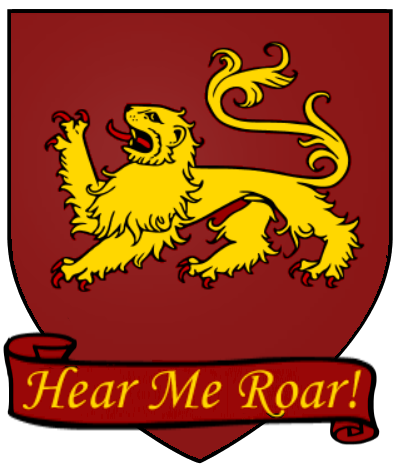
| Hear me roar! |
8. The Lannisters can sell the chance to slap Joffery. That is more valuable than food, even to a starving man.
Warning: I am only about half way through the third book. Some of this may be silly and wrong if I am missing key facts.
